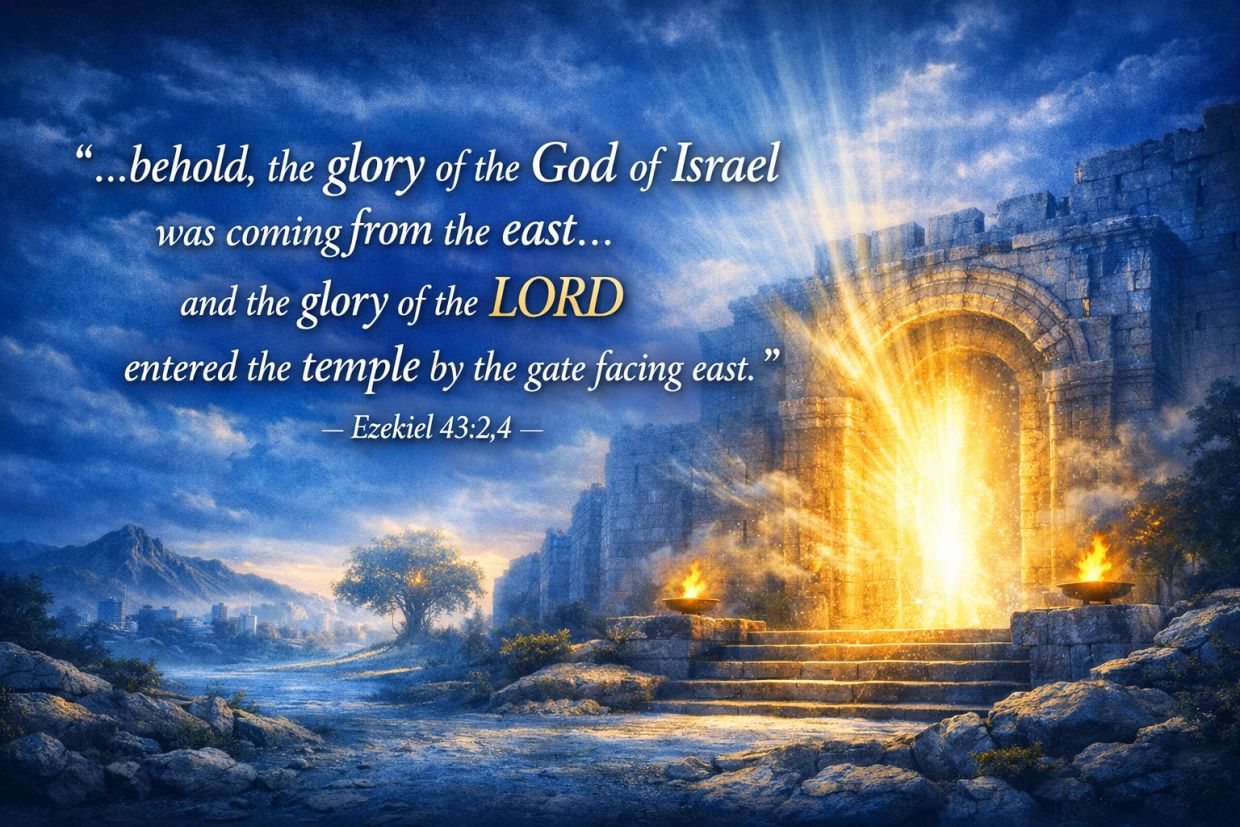
The East Gate: The Gate of GOD's Movement
“Where GOD moves becomes holy. Where GOD enters becomes set apart.”
Ezekiel 43:1-5
1 Afterward he brought me to the gate, the gate that faces toward the east. 2 And behold, the glory of the God of Israel came from the way of the east. His voice was like the sound of many waters; and the earth shone with His glory. 3 It was like the appearance of the vision which I saw—like the vision which I saw when I came to destroy the city. The visions were like the vision which I saw by the River Chebar; and I fell on my face. 4 And the glory of the Lord came into the temple by way of the gate which faces toward the east. 5 The Spirit lifted me up and brought me into the inner court; and behold, the glory of the Lord filled the temple.
There is a moment in Scripture where everything slows down and the focus settles on a single gate. It is the East Gate in Ezekiel’s vision. At first it seems like a simple architectural detail, but it becomes one of the most powerful prophetic images in the entire book. Through this gate the glory of GOD departs, and through this same gate the glory returns. It becomes the hinge point of Ezekiel’s message and the foundation of the East Gate theme that runs throughout Scripture. If you are stepping into a new season in your life, your family, or your walk with GOD, this image offers clarity, direction, and hope. It shows how GOD moves, how GOD restores, and how GOD leads His people forward.
Ezekiel 43 gives us the heart of this revelation. The prophet is brought to the gate facing east, and he sees the glory of the GOD of Israel coming from the east. The sound is like rushing waters, and the whole earth shines with His glory. The presence of GOD enters the temple through the East Gate. This is not a random detail. This is the direction of GOD’s return.
Before the glory returned, it first departed. In Ezekiel 10 and 11, the glory lifts from the temple, moves to the threshold, pauses at the East Gate, and then departs toward the mountain east of the city. The East Gate becomes the place where the movement of GOD can be seen and recognized. Years later, Ezekiel sees the reverse. The glory comes back from the east, the earth shines again, and the presence of GOD enters through the same gate. The direction of departure becomes the direction of restoration.
Because of this, the East Gate becomes the gate of transition. Every major movement in Ezekiel’s vision happens at this gate. The departure of the glory. The return of the glory. The consecration of the temple. The royal entry of the Prince.
- Departure (Ezekiel 10–11)
- Return (Ezekiel 43)
- Consecration (Ezekiel 44)
- Royal entry (Ezekiel 46)
The East Gate stands between seasons. It is the place where GOD shifts things. It is the place of sunrise, new beginnings, and divine movement.
The East Gate is also the gate of consecration. In Ezekiel 44, GOD declares that the gate will remain shut because the LORD, the GOD of Israel, has entered through it. The gate is shut not to keep people out, but to honor the fact that GOD passed through it. This reveals something important. Where GOD moves becomes holy. Where GOD enters becomes set apart. Consecration is not about human effort. It is about divine presence. When GOD touches something, that place becomes marked.
Ezekiel also shows us that the East Gate is the gate of the Prince. In chapter 46, the Prince enters through this gate, pointing forward to Messiah. This connects Ezekiel’s vision to Yeshua entering Jerusalem from the Mount of Olives to the prophecy of His return to that same mountain, and to the early church’s expectation that the coming of the Lord would be connected to the east. The East Gate becomes the gate of the King.
So, what does this mean for you as a follower of Yeshua today? First, it reminds you that GOD initiates movement. You do not have to force revival in your own life or manufacture spiritual seasons. You simply turn your heart toward the direction of His movement. Second, it teaches that GOD marks transitions. Just as the East Gate marked departure and return, GOD marks the transitions in your life. Third, it shows that GOD consecrates what He touches. When GOD moves in your heart, your home, or your calling, that space becomes holy. Finally, it invites you to become a person who watches, welcomes, aligns, and honors His movement. This is the posture of someone stepping into a new season with GOD.
As we begin this series, remember that the East Gate is not about striving. It is not about pressure or performance. It is about posture. It is about becoming someone who faces the direction of GOD’s movement, who honors His presence, and who prepares for His return. In the next teaching, we will go back to the beginning, to Eden, and see how the East Gate theme begins in the very first pages of Scripture.
Reflection Questions
Where do you sense GOD initiating movement in your life?
What would it look like for you to face the direction of His movement?
How can you cultivate sensitivity to GOD’s timing in your daily walk?
Continue the Journey
Return to the top and explore the next teaching in the East Gate Series.
Back to the Beginning: The First East Gate in Eden
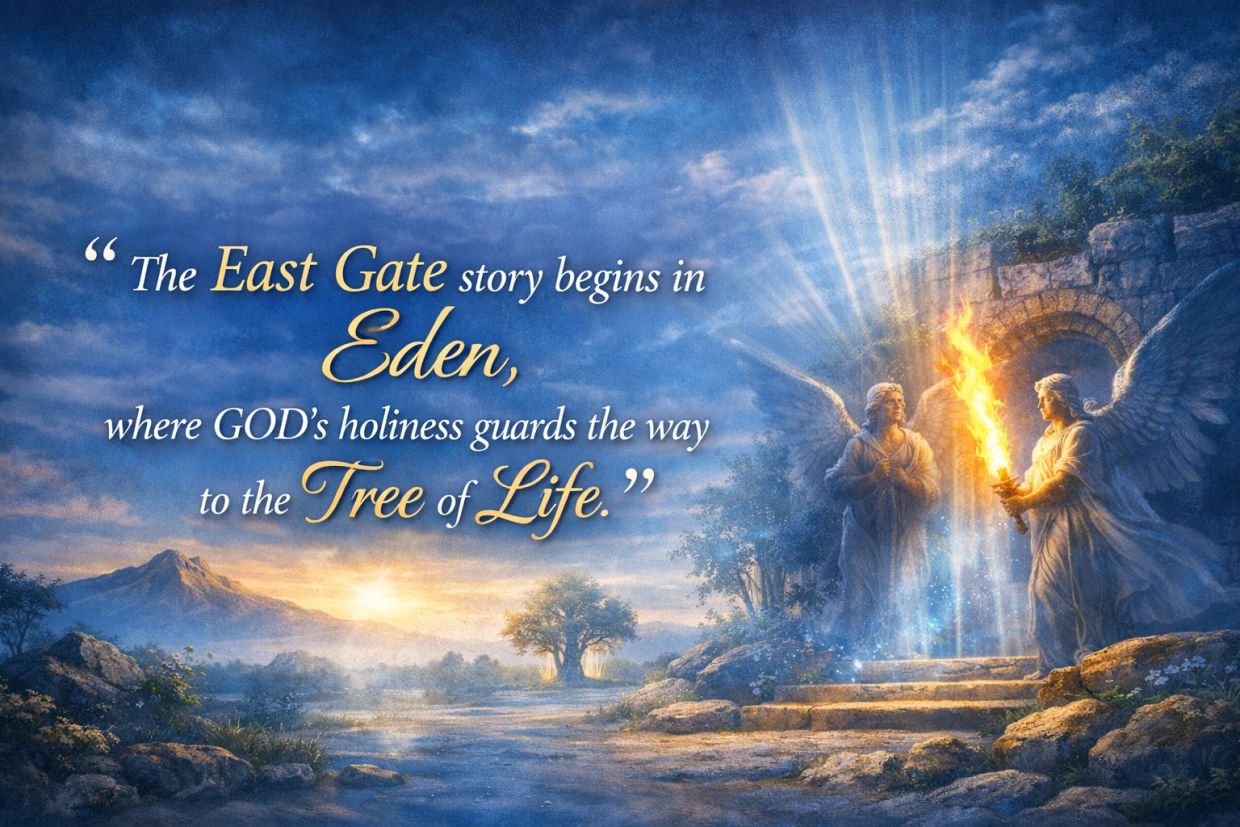
“The East Gate story begins in Eden, where GOD’s holiness guards the way to the Tree of Life.”
When we think of the East Gate, our minds often go straight to Ezekiel’s vision, where the glory of GOD departs and returns through the gate facing east. But the story of the East Gate does not begin with Ezekiel. It begins in Eden. To understand the meaning of the East Gate in prophecy, we have to return to the first time Scripture mentions the east side of GOD’s dwelling place. This first mention sets the pattern for everything that follows, including the imagery Ezekiel sees centuries later. In this teaching, we will explore the first East Gate and discover what it reveals about GOD’s heart, GOD’s holiness, and GOD’s plan for restoration.
Genesis 3:24
24 "So He drove out the man; and He placed cherubim at the east of the garden of Eden, and a flaming sword which turned every way, to guard the way to the tree of life."
The foundational verse is Genesis 3:24. After Adam and Eve are sent out of the garden, GOD places cherubim at the east side of Eden with a flaming sword that turns in every direction to guard the way to the Tree of Life. Scripture does not call this a gate by name, but it functions exactly like one. It is a boundary, a direction, a place of transition, a guarded entrance, and a holy threshold. And it is on the east side. This moment becomes the seed of the entire East Gate theme.
The east side of Eden becomes the first place in Scripture marked by holiness and protection. GOD does not place ordinary angels there. He places cherubim, the beings who guard His presence, surround His throne, and carry His glory. Wherever cherubim appear, holy space is being marked. The east side of Eden becomes the first boundary where heaven and earth meet and where access to GOD’s presence is guarded. The direction matters because the east is the direction of GOD’s presence, GOD’s movement, new beginnings, sunrise, and transition. From the very beginning, the east becomes the place where GOD’s story unfolds.
After the fall, humanity moves eastward. Adam and Eve leave Eden toward the east. Cain goes even further east in Genesis 4. Humanity drifts eastward again in Genesis 11 as they settle in Shinar. East becomes the direction of exile, wandering, and distance from GOD. But here is the beauty. The direction of exile becomes the direction of return. What begins as separation becomes the pathway of restoration.
Once you see Genesis 3:24, the book of Ezekiel suddenly comes alive. The patterns match. In Eden, GOD’s presence is in the garden, the east side is guarded, cherubim mark the boundary, and humanity moves eastward in exile. In Ezekiel, GOD’s presence departs toward the east, the glory pauses at the East Gate, cherubim appear again, and the glory returns from the east. The East Gate is shut because GOD entered through it. The story of Eden is being reversed. What was lost in Eden is being restored in Ezekiel.
This reveals something powerful. The East Gate is not about rejection; it becomes a place of restoration. In Eden, the east side is guarded because of sin. In Ezekiel, the east side is consecrated because of glory. In Eden, humanity is sent eastward in exile. In Ezekiel, GOD returns from the east to restore His people. In Eden, cherubim guard the way to the Tree of Life. In Ezekiel, cherubim accompany the glory as it returns. The East Gate is the story of redemption. It is GOD saying, "I will restore what was lost. I will return what was removed. I will reopen what was closed."
So what does this mean for you today. First, it means GOD restores what was lost. The East Gate is the gate of return, both for GOD and for His people. Second, it means GOD reverses exile. Where you have felt distance from the LORD, HE brings you closer. Where there has been wandering, GOD brings direction. Third, it means GOD guards what is holy. Just as cherubim guarded Eden, GOD guards the work He is doing in your life. Finally, it means GOD prepares you for new beginnings. East is the direction of the sunrise, and with every sunrise a new day begins and HIS mercies are renewed. As a result, the East Gate is now the gate of new seasons and new beginnings.
The East Gate in Eden and the East Gate in Ezekiel are not two separate stories. They are one story intertwined to reveal GOD’s presence, GOD’s holiness, and GOD’s restoration. Eden shows us the problem but Ezekiel shows us the promise. Together, they reveal that GOD is always moving His people from exile to return, from distance to closeness, from loss to restoration. In our next teaching, we will explore how this theme continues through Israel’s history, from exile in Babylon to return through the east, and how this movement shapes the way GOD leads His people into new seasons.
Reflection Questions
What does Eden teach you about GOD’s holiness and boundaries?
How does the Eden pattern help you understand Ezekiel’s vision?
Where might GOD be restoring what was lost in your life or community?
Continue the Journey
Return to the top and explore the next teaching in the East Gate Series.
From Exile to Return: The Biblical Pattern of the East
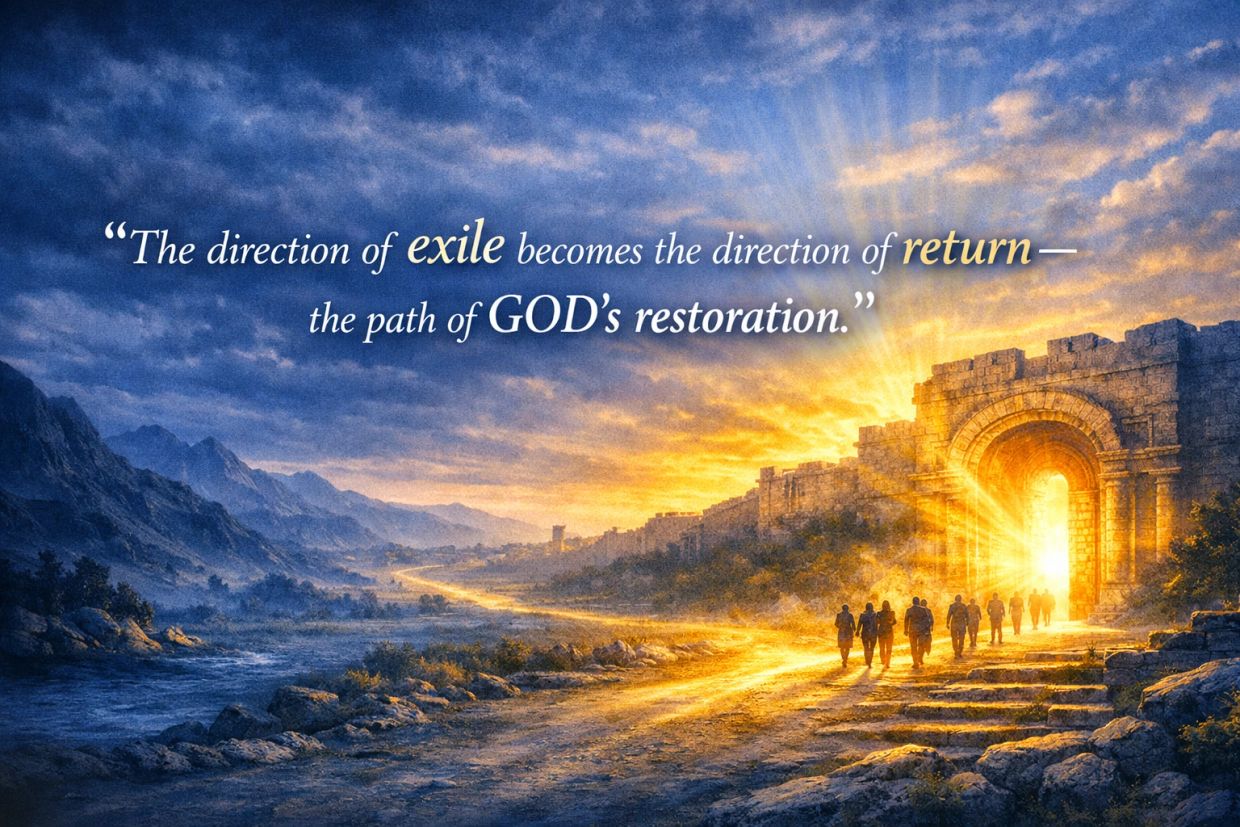
“The direction of exile becomes the direction of return; the path of GOD’s restoration.”
Throughout Scripture, the direction of the east carries deep meaning. It is the direction of exile and the direction of return. From Eden to Babylon to Ezekiel to Yeshua, the east becomes the pathway of GOD’s movement and the rhythm of departure and restoration. This pattern reveals GOD’s heart for redemption and helps us understand how He leads His people through seasons of loss and renewal.
In the first two teachings, we saw the East Gate in Ezekiel as the place of GOD’s movement and the east side of Eden as the first holy boundary. Now we step back and look at the entire biblical pattern. From Genesis to Revelation, the east‑to‑west movement becomes a thread of divine purpose. GOD often moves His people through exile and return, and the direction of that movement is consistently east to west. Understanding this pattern helps us discern how GOD is working in our own lives today.
Genesis 3:24
24 So He drove out the man; and He placed cherubim at the east of the garden of Eden, and a flaming sword which turned every way, to guard the way to the tree of life.
Genesis 4:16
16 Then Cain went out from the presence of the Lord and dwelt in the land of Nod on the east of Eden.
After the fall, humanity moves eastward. Adam and Eve are sent out of Eden toward the east. Cain goes further east, away from GOD’s presence. Humanity settles eastward in Shinar to build the Tower of Babel. Centuries later, Israel is exiled to Babylon, which lies east of Jerusalem. The east becomes the direction of exile, wandering, discipline, and distance from GOD. Yet even in this movement, there is hope. The direction of exile becomes the direction of return.
When GOD restores His people, He brings them back from the east. The exiles return from Babylon, traveling westward toward Jerusalem. Isaiah prophesies that GOD will bring His offspring from the east (Isaiah 43:5) . Ezekiel sees the glory of the GOD of Israel coming from the way of the east (Ezekiel 43:2). Yeshua enters Jerusalem from the Mount of Olives, the eastern approach (Matthew 21:1-11), and Scripture tells us He will return to that same mountain (Zechariah 14:4). The east becomes the direction of restoration, redemption, and new beginnings. It is the direction of the King’s arrival.
The East Gate stands as the turning point of this story. In Eden, humanity moves eastward in exile while cherubim guard the way back to life. In Israel’s history, the people are exiled to the east and later return from the east to rebuild the temple. In Ezekiel, the glory departs eastward and returns from the east, consecrating the gate. In Yeshua, the pattern reaches its fulfillment as He enters Jerusalem from the east, ascends from the Mount of Olives, and will return there again. For the Church, this means we are called to be a people who welcome His return, who live in restoration, and who face the direction of GOD’s movement. The East Gate is the hinge between exile and restoration.
This pattern reveals GOD’s heart for His people. It is not just geography; it is Biblical truth. It is the story of redemption where GOD does not leave His people in exile and always creates a path of return. He restores from the same direction He disciplines. The place of loss becomes the place of restoration. GOD moves toward His people before they move toward Him. In Ezekiel, the glory returns before the people rebuild. GOD prepares His people for new beginnings as represented in that the east is the direction of sunrise, new creation, and resurrection.
For you, this pattern speaks to seasons of transition. If you have felt scattered, stretched, or unsettled, GOD is preparing a return. Exile is never the end of the story. GOD is bringing alignment with His movement. Just as Israel returned from the east, GOD is drawing you back into His purposes. He is restoring what was lost and preparing you for a new season.
From Eden to Babylon to Ezekiel to Yeshua, the east is the direction of exile and the direction of return. It is the direction of loss and the direction of restoration. It is the direction of departure and the direction of glory. This is the rhythm of GOD’s movement, and you are invited to step into that rhythm and face the direction of His return, Welcome His presence and prepare for the new season He is bringing. In the next teaching, we will explore the cherubim, the guardians of GOD’s presence, and how their role at every major East Gate moment reveals a pattern for intercession, discernment, and spiritual protection.
Reflection Questions
What “exile‑to‑return” patterns do you see in your own story?
How can you partner with GOD in His work of restoration?
What does it mean for you to prepare for a “return season”?
Continue the Journey
Return to the top and explore the next teaching in the East Gate Series.
Guardians of Presence: An Example for our Intercession
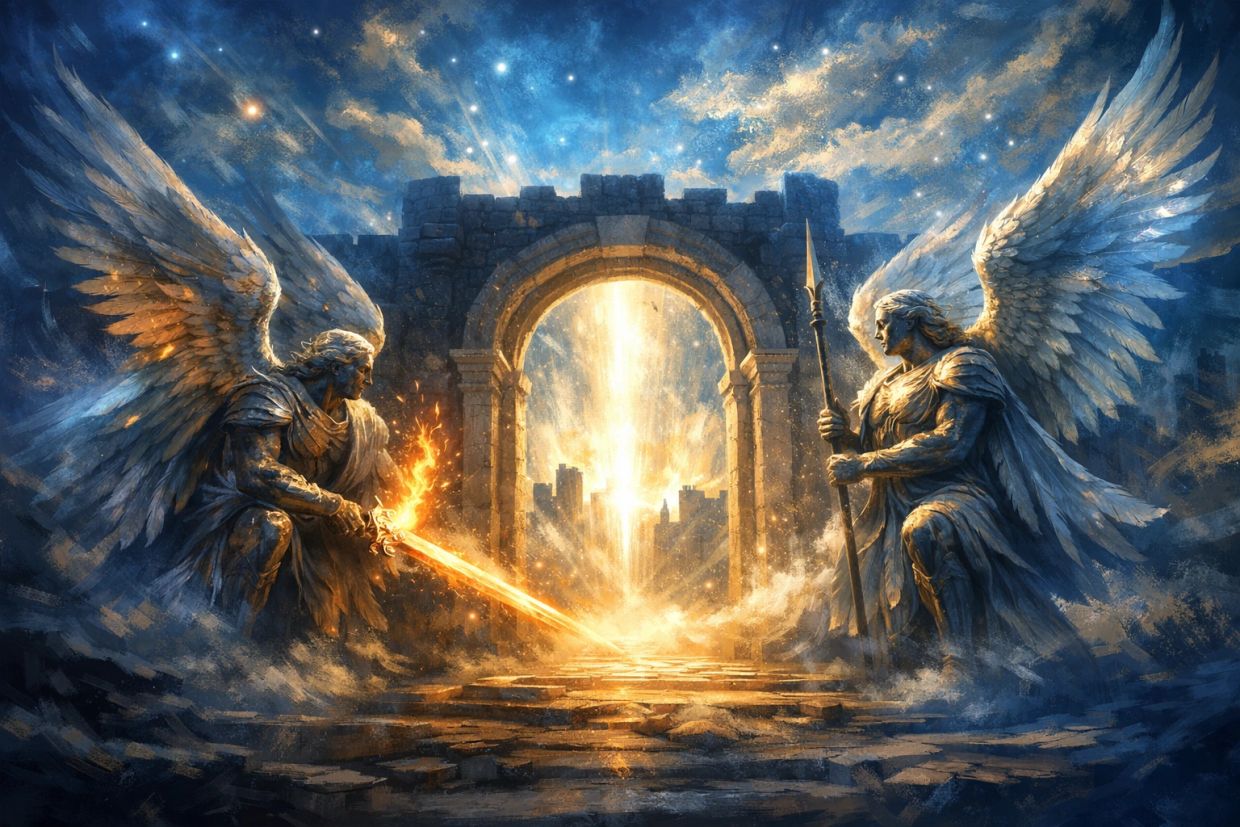
“Cherubim show us how to watch, guard, and welcome His Presence in times of Intercession"
This teaching is not meant to focus our attention on the Cherubim themselves, but to teach us about posture. The cherubim show us how to posture ourselves as a church entering a new season. We guard what GOD is doing. We protect unity, holiness, and presence. We watch for GOD’s movement. We listen and discern. We move with GOD, not ahead of Him. We do not force seasons or manufacture revival. We align with His timing. We welcome His presence. We prepare room. We honor His movement. We open our hearts. We become a people of presence. Not striving. Not performing. Not pressuring. Simply hosting, guarding, and welcoming the presence of GOD.
We have already seen the East Gate in Ezekiel as the place of GOD’s movement, the first East Gate in Eden as the guarded boundary of GOD’s presence, and the biblical pattern of the east as the direction of exile and return. Now we turn to the cherubim, the heavenly beings who stand at the center of all these moments. They appear at the east of Eden, in the Holy of Holies, in Ezekiel’s visions, and at the East Gate during the movement of GOD’s glory. Every time they appear, they carry the same function. They guard the presence, they watch the movement of GOD, they mark holy boundaries and they model intercession.
Genesis 3:24
24 So He drove out the man; and He placed cherubim at the east of the garden of Eden, and a flaming sword which turned every way, to guard the way to the tree of life.
In Eden, the cherubim are the guardians of holy space. Genesis 3:24 tells us that GOD placed cherubim at the east of the garden to guard the way to the Tree of Life. This is the first gatekeeping moment in Scripture. Their role is not punishment, but rather they stand as protection by guarding the presence of GOD. They protect the way to life and mark the boundary between holy and unholy. They stand at the place of transition, guarding what is sacred. This sets the pattern for everything that follows.
Exodus 25:18-22
18 And you shall make two cherubim of gold; of hammered work you shall make them at the two ends of the mercy seat. 19 Make one cherub at one end, and the other cherub at the other end; you shall make the cherubim at the two ends of it of one piece with the mercy seat. 20 And the cherubim shall stretch out their wings above, covering the mercy seat with their wings, and they shall face one another; the faces of the cherubim shall be toward the mercy seat. 21 You shall put the mercy seat on top of the ark, and in the ark you shall put the Testimony that I will give you. 22 And there I will meet with you, and I will speak with you from above the mercy seat, from between the two cherubim which are on the ark of the Testimony, about everything which I will give you in commandment to the children of Israel
In the Tabernacle, cherubim appear again. This time they cover the mercy seat in the Holy of Holies. GOD commands Moses to make two cherubim of gold, overshadowing the place where He speaks. Their wings cover the holiest space on earth. In the place they symbolize GOD’s throne and His nearness. Just as in Eden, they guard holy presence and mark the space where heaven touches earth.
Ezekiel 10:17-18
17 When the cherubim stood still, the wheels stood still, and when one was lifted up, the other lifted itself up, for the spirit of the living creature was in them.
18 Then the glory of the Lord departed from the threshold of the temple and stood over the cherubim.
In Ezekiel’s visions, cherubim are bearers of GOD’s glory. Ezekiel 1 describes living creatures carrying GOD’s throne. Ezekiel 10 identifies them explicitly as cherubim. They move when GOD moves and stop when GOD stops. They are full of eyes, which is imagery of watchfulness and discernment. They carry the presence and accompany the glory to the East Gate. This is Eden again, but now in motion. The same guardians who stood still in Eden now move with GOD’s glory.
At the East Gate, the cherubim mark GOD’s movement when the glory departs in Ezekiel 10 and 11. When the glory pauses at the East Gate, they are there. And then again when the glory returns from the east in Ezekiel 43. The presence of GOD moves through the east, accompanied by heavenly guardians. The message is clear. Where GOD moves, cherubim appear. Where GOD dwells, cherubim guard. Where GOD transitions, cherubim watch. They are the ultimate watchers. They are the original intercessors.
Cherubim teach us what true intercession looks like. They show us that Intercession is all about the presence of GOD. Along with this, Cherubim do not strive or wrestle. They simply carry the presence, guard the presence, and honor the presence. All Intercession needs to begin with presence. Intercession is about watching, not forcing. We can see this demonstrated by the imagery of the Cherubim being full of eyes. They see, they discern, and they pay attention. Your Intercession should begin with awareness. Cherubim move only when GOD moves and stop when GOD stops, setting the example of how our intercession should move as GOD moves and not try to "force" movement when there is none. Our intercession needs to be a synchronization with the movement of the LORD. Our intercession should be about guarding what GOD is doing, when HE is doing it. Cherubim also guard holy spaces, protect the work of GOD, and mark boundaries. Intercession is all about operating with stewardship, welcoming GOD’s movement, and being in agreement with HIS plans and purposes.
This impartation is not meant to focus our attention on the Cherubim themselves, but to teach us about the posture we need to take. The cherubim show us how to posture ourselves as a church, and as individuals, as we seek to operate under HIS guidance. We should be guarding what GOD is doing, protect unity, holiness, and HIS presence. We should take up our position on the wall and watch for GOD’s movement, listening and discerning, so we move in step with the LORD and not ahead of Him. In this posture we do not try to force seasons or manufacture revival. We simply align with GOD’s timing, welcome His presence, prepare room, and honor His movement. With open hearts, we become a people of presence who do not strive or perform, but simply host, guard, and welcome the presence of GOD.
From Eden to the Tabernacle to Ezekiel, the cherubim reveal a consistent truth that GOD’s presence is holy and intentional. As people of GOD we are called to watch, guard, and welcome His presence and HIS movement. This is the heart of intercession and the posture of the East Gate.
In the next teaching, we will explore how the East Gate becomes the gate of order, consecration, and alignment, and how these three themes shape the way we prepare for GOD’s movement today.
Reflection Questions
How can you cultivate a watching posture as a believer?
What does it look like to guard what GOD is doing?
How can you move with GOD instead of ahead of Him?
Continue the Journey
Return to the top and explore the next teaching in the East Gate Series.
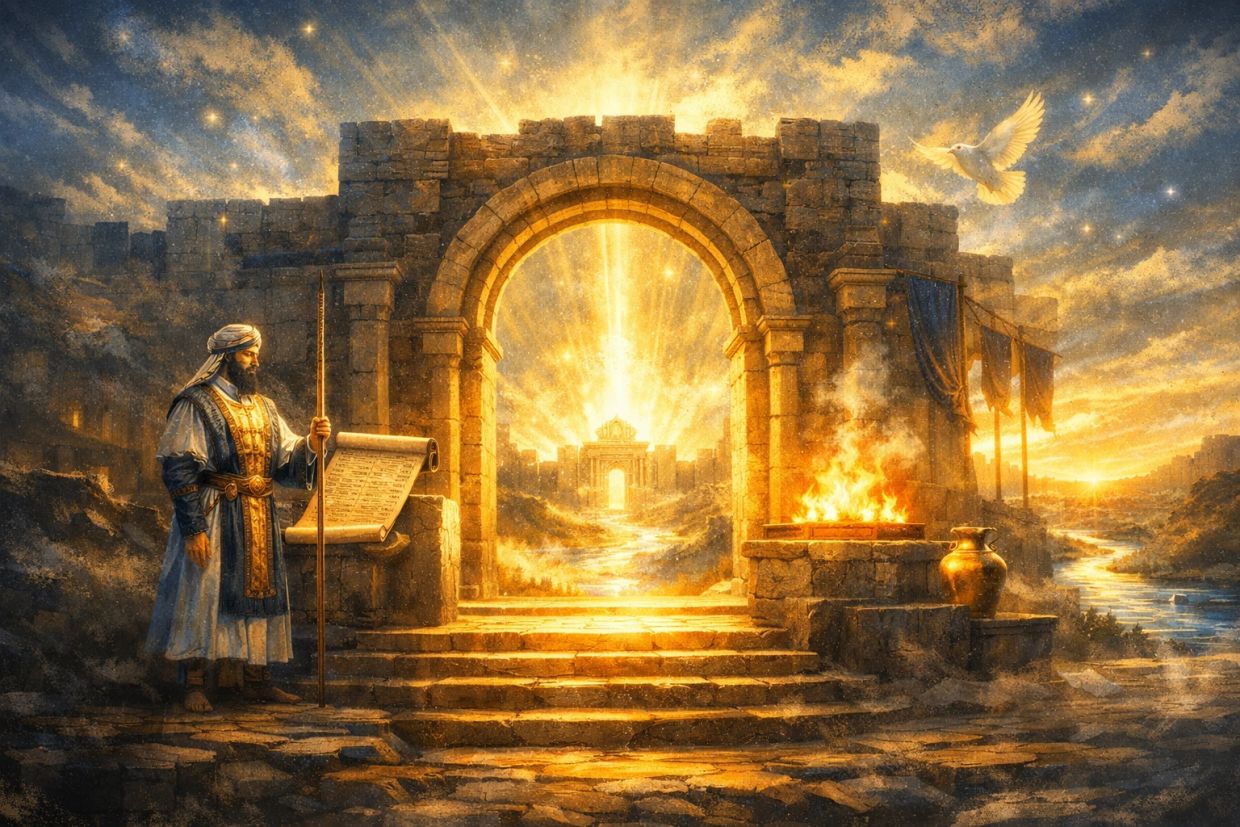
The Gate of Order, Consecration, and Alignment
“Before GOD brings glory, He brings order, He consecrates and aligns His people with His movement.”
Before GOD brings glory, He brings order. Before He moves, He consecrates. Before He restores, He aligns. The East Gate reveals the priorities of GOD’s heart and the way He prepares His people for a new season.
We have already seen the East Gate as the place of GOD’s movement, the first East Gate in Eden, the biblical pattern of exile and return, and the cherubim as guardians of presence and models of intercession. Now we turn to one of the most important themes in Ezekiel’s vision. The East Gate is the gate of order, consecration, and alignment. These are not abstract ideas but are the spiritual architecture of how GOD prepares His people for what He is about to do.
Ezekiel 40:6-11
6 Then he went to the gateway which faced east; and he went up its stairs and measured the threshold of the gateway, which was one rod wide, and the other threshold was one rod wide. 7 Each gate chamber was one rod long and one rod wide; between the gate chambers was a space of five cubits; and the threshold of the gateway by the vestibule of the inside gate was one rod. 8 He also measured the vestibule of the inside gate, one rod. 9 Then he measured the vestibule of the gateway, eight cubits; and the gateposts, two cubits. The vestibule of the gate was on the inside. 10 In the eastern gateway were three gate chambers on one side and three on the other; the three were all the same size; also the gateposts were of the same size on this side and that side.
11 He measured the width of the entrance to the gateway, ten cubits; and the length of the gate, thirteen cubits.
We begin with order. In Ezekiel 40, the man with the measuring rod begins his tour of the restored Temple. The first gate he measures is the East Gate. This becomes the reference point for the entire layout. In Scripture, first means priority. The East Gate establishes orientation, direction, structure, and sequence. Everything else in the Temple is measured in relation to it. This reveals something important about GOD, that He is not chaotic or random, and does not improvise. GOD brings order before He brings glory. For the church, this means that before GOD moves in a new season, He brings clarity, structure, alignment, right priorities, and right relationships. Order is not about control, but about preparation.
Ezekiel 44:1-3
1 Then He brought me back to the outer gate of the sanctuary which faces toward the east, but it was shut. 2 And the Lord said to me, “This gate shall be shut; it shall not be opened, and no man shall enter by it, because the Lord God of Israel has entered by it; therefore it shall be shut. 3 As for the prince, because he is the prince, he may sit in it to eat bread before the Lord; he shall enter by way of the vestibule of the gateway, and go out the same way.”
Next we see consecration. In Ezekiel 44, GOD declares that the East Gate shall remain shut because the LORD, the GOD of Israel, has entered through it. The gate is shut not to keep people out but to honor the presence that passed through it. Where GOD moves becomes holy and where HE enters becomes consecrated. When the LORD touches something it becomes set apart. GOD marks what He touches. and then protects what He has sanctified. GOD honors the places where His glory rests. When GOD begins a new season, He sets apart people, spaces, ministries, and moments. Consecration is GOD saying, “This belongs to Me.”
Ezekiel 43:1-7
1 Afterward he brought me to the gate, the gate that faces toward the east. 2 And behold, the glory of the God of Israel came from the way of the east. His voice was like the sound of many waters; and the earth shone with His glory. 3 It was like the appearance of the vision which I saw—like the vision which I saw when I came to destroy the city. The visions were like the vision which I saw by the River Chebar; and I fell on my face. 4 And the glory of the Lord came into the temple by way of the gate which faces toward the east. 5 The Spirit lifted me up and brought me into the inner court; and behold, the glory of the Lord filled the temple.
6 Then I heard Him speaking to me from the temple, while a man stood beside me. 7 And He said to me, “Son of man, this is the place of My throne and the place of the soles of My feet, where I will dwell in the midst of the children of Israel forever. No more shall the house of Israel defile My holy name, they nor their kings, by their harlotry or with the carcasses of their kings on their high places.
Ezekiel 47:1
1 Then he brought me back to the door of the temple; and there was water, flowing from under the threshold of the temple toward the east, for the front of the temple faced east; the water was flowing from under the right side of the temple, south of the altar.
Finally, we come to alignment. In Ezekiel 43 and 47, everything in the restored Temple is oriented toward the east. The altar faces east, the steps face east, the river flows east, and the movement of glory comes from the east. Alignment is the posture of restoration. Alignment is not busyness, activity, striving, or forcing outcomes. Alignment is facing the direction of GOD’s movement. It is synchronizing with His timing and agreeing with His will. It is moving when He moves and stopping when He stops. GOD leads, directs, and initiates and then invites His people to follow. A new season requires a new posture of sensitivity, attentiveness, and obedience. Alignment is the posture we take when we say “Lord, whatever You are doing, we want to face it.”
Order, consecration, and alignment work together. They are not separate themes as each one build upon the other. When the LORD sets things in place HE marks what is His and brings His people into harmony with His movement. This is the pattern of revival and restoration. This is the pattern of the East Gate.
The East Gate gives us a blueprint for every new season in our journey with the LORD. GOD brings order, clarity, and structure to prepare us, setting us apart for worship, intimacy, and mission. The LORD is aligning our hearts with His movement so we can walk in our identity and bring honor and glory to His name.
The East Gate teaches us that GOD prepares His people before He moves. He brings order. He consecrates. He aligns. And when these three things come together, the stage is set for the return of His glory.
In the next teaching, we will explore the Messianic dimension of the East Gate and how it becomes the gate of the Prince, the gate of the King, and the gate of Yeshua's movement in the Gospels and in the age to come.
Reflection Questions
Where is GOD bringing order in your life or in your church?
What is GOD consecrating in this season?
How can you align yourself more fully with His movement?
Continue the Journey
Return to the top and explore the next teaching in the East Gate Series.

The East Gate and the Coming King
“The East Gate points to Jesus, the Prince who came and the King who will return.”
The East Gate is the gate of the Prince, the gate of Yeshua. He entered Jerusalem from the east, ascended from the east, and will one day return from the east. This is the gate of the King, the gate of Messiah, and the gate that completes the story of GOD’s movement through history.
We have already explored the East Gate as the place of GOD’s movement, the first East Gate in Eden, the biblical pattern of exile and return, the cherubim as guardians of presence, and the East Gate as the gate of order, consecration, and alignment. Now we come to one of the most powerful truths in Ezekiel. The East Gate is the gate of the King. It is the gate through which Yeshua entered and the gate through which He will return. This teaching brings the entire series together.
Ezekiel 44:1-3
1 Then He brought me back to the outer gate of the sanctuary which faces toward the east, but it was shut. 2 And the Lord said to me, “This gate shall be shut; it shall not be opened, and no man shall enter by it, because the Lord God of Israel has entered by it; therefore it shall be shut. 3 As for the prince, because he is the prince, he may sit in it to eat bread before the Lord; he shall enter by way of the vestibule of the gateway, and go out the same way.”
In Ezekiel 44, GOD declares that the East Gate shall remain shut because the LORD, the GOD of Israel, has entered through it. Only the Prince may sit in it to eat bread before the LORD. The gate is shut to everyone except the Prince because GOD Himself entered through it. It is consecrated, reserved for royal access, and marked as a gate of covenant and communion. This is not a mere architectural detail. It is a prophecy pointing forward to Jesus.
Throughout Ezekiel 40–48, the Prince is portrayed as a ruler, a shepherd, a worship leader, and a covenant representative who brings order and justice. He is not a priest or a political king. He is a Messianic figure, a prophetic picture of the One who would come. The Prince enters through the East Gate, leads worship, offers sacrifices, and represents the people before GOD. Every image finds its fulfillment in Jesus.
Matthew 21:1
1 Now when they drew near Jerusalem, and came to Bethphage, at the Mount of Olives, then Jesus sent two disciples,
In the Gospels, Jesus approaches Jerusalem from Bethany, Bethphage, and the Mount of Olives. All of these are on the east side of the city of Jerusalem. His triumphal entry in Matthew 21 is not coincidence. It is fulfillment. He is intentionally stepping into the prophetic imagery of Ezekiel, declaring, “I am the Prince who enters through the East Gate.” The direction of His entry mirrors the returning exiles, the returning glory, and the movement of GOD’s presence. The east becomes the direction of redemption.
Acts 1:9, 12
9 Now when He had spoken these things, while they watched, He was taken up, and a cloud received Him out of their sight.
12 Then they returned to Jerusalem from the mount called Olivet, which is near Jerusalem, a Sabbath day’s journey.
After His resurrection, Jesus ascends from the Mount of Olives, again from the east. It is the place of return, restoration, alignment, and glory. This is the same mountain where the glory paused in Ezekiel 11, facing the East Gate. The pattern continues where the movement of GOD’s glory and the movement of the Son are perfectly aligned.
Scripture also tells us that Jesus will return from the east. Zechariah 14:4 says His feet will stand on the Mount of Olives. Revelation 22 describes the river of life flowing from the throne, echoing Ezekiel 47 where the river flows eastward. Matthew 24:27 declares that as lightning comes from the east, so will the coming of the Son of Man be. The east is the direction of His first coming, His ascension, and His return. The East Gate is the gate of the King.
The East Gate is a picture of Yeshua's ministry. It is the gate of presence because Yeshua is Emmanuel, GOD with us. It is the gate of consecration because HE is the Holy One who sanctifies His people. It is the gate of alignment because Yeshua aligns heaven and earth, GOD and humanity. It is the gate of restoration because Yeshua restores what was lost in Eden. And it is the gate of kingship because Yehsua is the Prince who enters through the gate reserved for Him.
For the church, this truth becomes deeply practical. We are a people who prepare for the King. Our worship, unity, and posture all prepare the way. We are a people who welcome His presence, honoring the movement of GOD. We are a people who align with His leadership, moving with the King rather than running ahead or lagging behind. We are a people who live with expectation, looking toward His return, His reign, and His glory. We are a people who carry hope, because the East Gate is the gate of restoration, the gate of new beginnings, and the gate of the King.
The East Gate is not just a prophetic detail. It is a living picture of Yeshua; His coming, His presence, His kingship, and His return. It reminds us that GOD is moving, GOD is restoring, GOD is returning, and GOD is leading His people into a new season. As a church, we are invited to prepare the way of the King.
In the final teaching, we will bring everything together and explore what it means to become an East Gate people and how we are a church positioned for GOD’s movement, aligned with His presence, and ready for the season ahead.
Reflection Questions
How can we prepare our church for the King’s movement?
What does it look like to live with expectation?
How can we cultivate a culture that welcomes Jesus’ presence?
Continue the Journey
Return to the top and explore the next teaching in the East Gate Series.
An East Gate Church Positioned for GOD’s New Season
"East Gate people are a people of presence, alignment, restoration, and hope.”
As we step into this final impartation of the East Gate Series, our prayer is that these teachings have strengthened your walk and stirred your spirit. If you have not yet read the earlier parts of the series, we encourage you to begin there. Each impartation builds upon the last, and this final message gathers all of them together into one clear call that will help posture your heart for the next steps in your journey with the LORD.
The East Gate is more than a location in Scripture. It is a posture. It is the way GOD forms a people who welcome His movement, host His presence, and prepare for the season He is bringing. Throughout this series we have walked through the East Gate in Ezekiel, the first East Gate in Eden, the pattern of exile and return, the cherubim as guardians of presence, the East Gate as the gate of order, consecration, and alignment, and the East Gate as the gate of the King. Now we arrive at the question that brings everything home, "What does it mean for us, as a church, to become an East Gate people?" We are not talking about a build, but more importantly we are talking about our posture. our calling and our way of being.
Ezekiel 43:1-2
1 Afterward he brought me to the gate, the gate that faces toward the east. 2 And behold, the glory of the God of Israel came from the way of the east. His voice was like the sound of many waters; and the earth shone with His glory.
An East Gate people are first a people of presence. The glory departs through it and the glory returns through it. The gate is shut because GOD's presence entered through it. God's presence is the defining mark of the East Gate. For the church, this means we prioritize GOD’s presence above programs. We value encounter over entertainment, and we cultivate worship that honors Him. As an East Gate church, we need to create space for Him to move. where HIS presence is the center of everything we do.
Ezekiel 40:6-7
6 Then he went to the gateway which faced east; and he went up its stairs and measured the threshold of the gateway, which was one rod wide, and the other threshold was one rod wide. 7 Each gate chamber was one rod long and one rod wide; between the gate chambers was a space of five cubits; and the threshold of the gateway by the vestibule of the inside gate was one rod.
An East Gate people are also a people of order. Before the glory returns, GOD brings order. Ezekiel 40 begins with measurements, structure, and alignment. When the LORD brings order, HE is preparing. For the church, this means healthy leadership, clear vision, strong relationships, biblical foundations, and unity of heart and purpose. Order prepares the house for HIS presence.
An East Gate people are a people of consecration. The East Gate is shut because GOD entered through it. Consecration means that what GOD touches becomes holy. For the church, this means we honor what GOD is doing, we protect unity, we guard purity, and we set apart our worship, our time, and our hearts. We treat His presence with reverence. Consecration is not legalism because it is devotion to HIM.
An East Gate people are a people of alignment. Everything in the restored Temple faces east. The altar, the steps, the river, and the flow of life all turn toward the direction of GOD’s movement. Alignment means facing the direction of His leading. For the church, this means we listen, we discern, we respond, and we move with GOD rather than ahead of Him. We synchronize with His timing. Alignment is the posture of a people ready for a new season.
An East Gate people are a people of restoration. The east is the direction of exile, return, rebuilding, renewal, resurrection, and new beginnings. The East Gate is the gate of restoration. For the church, this means we believe GOD restores what was lost. We welcome prodigals. We rebuild what was broken. We heal what was wounded. We speak hope into dry bones. An East Gate church is a restoring church.
Zechariah 14:4
4 And in that day His feet will stand on the Mount of Olives,
Which faces Jerusalem on the east.
And the Mount of Olives shall be split in two,
From east to west,
Making a very large valley;
Half of the mountain shall move toward the north
And half of it toward the south.
An East Gate people are a people who prepare for the King. The East Gate is the gate of the Prince, the gate of Yeshua. He enters Jerusalem from the east. He ascends from the Mount of Olives. He will return to the Mount of Olives. He is the fulfillment of Ezekiel’s Prince. The East Gate is the gate of the King. For the church, this means we live with expectation. We prepare our hearts, our worship, our relationships, and our city. We are a people who say, “Lift up your heads, O gates, that the King of glory may come in.” (
An East Gate people are a people of hope. The East Gate faces the sunrise. It faces new mercies, new beginnings, new seasons, and new life. Hope is the atmosphere of the East Gate. For the church, this means we expect GOD to move. We believe GOD is restoring. We trust GOD’s timing. We look forward rather than backward. We carry hope into our city. An East Gate church is a hope‑filled church.
Becoming an East Gate people looks like a simple but powerful rhythm. We watch and pay attention to GOD’s movement. We welcome HIM and make room for His presence. We align ourselves to the face the direction of His leading. We honor His presence with reverence. We prepare for what He is doing next. We restore by partnering with Him to rebuild lives. We hope and live with expectation of His return. This is not a program or a man-made strategy. This is a posture.
The East Gate is more than a prophetic detail. It is a picture of the kind of people GOD is forming to be filled with, and live in, HIS presence. He is raising up people of order, consecration, and alignment. We are being called to be people of restoration and hope preparing for our King. As we step into a new season as a church, may we become an East Gate people. A people positioned for GOD’s movement, aligned with His presence, and ready for the glory that is returning.
Reflection Questions
What does it mean for us to become an East Gate people?
Where is GOD calling us to watch, welcome, align, and prepare?
How can we lead our church into a posture of hope and expectation?
Continue the Journey
Return to the top and explore the next teaching in the East Gate Series.